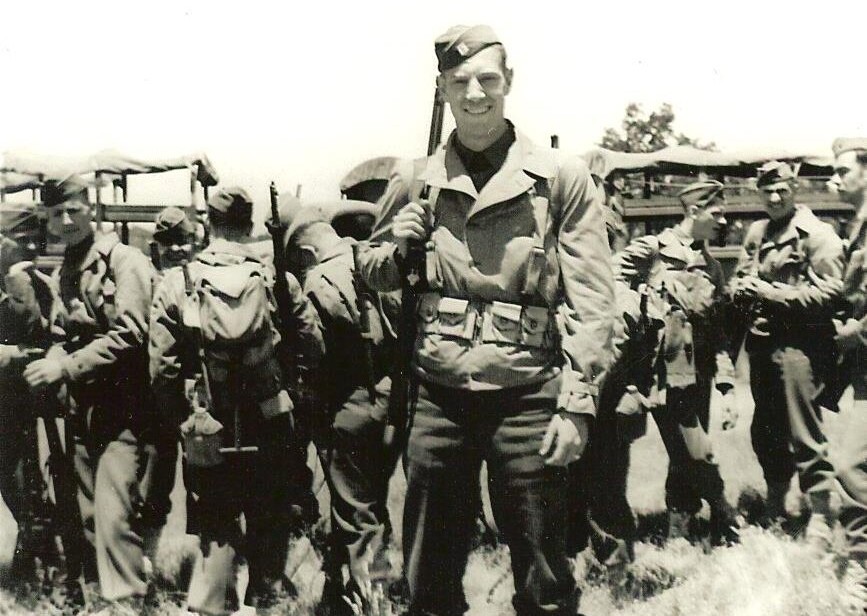
The husband, father, and basketball player whose extraordinary wartime experiences would one day inspire SHOT DOWN.
February 8, 1944. Six days before Valentine's Day
At an American airbase in England, First Lieutenant Howard Snyder prepared to fly another bombing mission over Nazi-occupied Europe.
His aircraft was a B-17 Flying Fortress named Susan Ruth.
The name painted on its fuselage belonged to his young daughter, waiting thousands of miles away in California with her mother, Ruth.
Howard was responsible for nine other men aboard that bomber. Each had a job to perform, a family or friends back home, and reasons to hope he would survive the war.
That morning, they were headed for Frankfurt, Germany.
By the end of the mission, Howard’s life would be changed forever.
The Man Beyond the Uniform
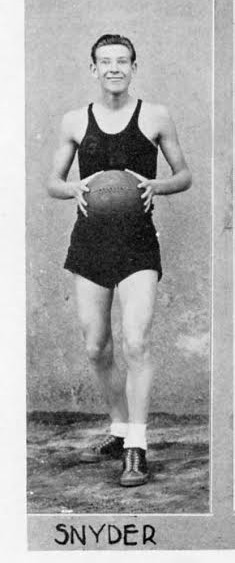
Howard Snyder as a member of his Glendale High School basketball team in 1933. He served as team captain and was named its most valuable player.
Years before he commanded a B-17, Howard Snyder captained his Glendale High School basketball team and earned recognition as its most valuable player.
Growing up in California, he played in YMCA and Amateur Athletic Union leagues. He was an experienced player, and those skills followed him across the Atlantic.
At Thurleigh, England, home of the 306th Bomb Group, Maj Robert “Rip” Riordan learned about Howard’s basketball background and recruited him for the 369th Squadron team.
The competition between squadrons was spirited. Howard remembered a particularly close game against the rival 367th Squadron. His team won 32–31, although Howard fouled out during the second half.
Howard played center, while Major Riordan played forward.
For men whose daily responsibilities included flying into enemy territory, basketball offered something different. There was competition, camaraderie, and an opportunity to enjoy an ordinary activity in extraordinary circumstances.
The games also helped Howard establish friendships and become part of his squadron.
In his account, Howard recalled that Major Riordan was pleased with his performance on the court. Riordan also mentioned the possibility of assigning him one of the newer B-17G bombers.
For Howard, that possibility mattered for a reason that had nothing to do with basketball.
A Father's Choice
B-17 Flying Fortress. Howard Snyder piloted a B-17 named Susan Ruth while serving with the 306th Bomb Group in England during World War II. Aircraft pictured is not identified as the Susan Ruth.
Howard had already decided he wanted to name his aircraft after his daughter.
But he wasn’t willing to put her name on just any bomber.
He wanted one of the newer B-17Gs, which offered improvements over earlier models, including a chin turret designed to provide additional protection against frontal attacks.
As Howard explained in the account preserved in SHOT DOWN:
“Anything that is connected with my little girl has to be exceptional.”
It’s a small statement that reveals something important about the man.
To others, the name painted on a bomber might have seemed like another example of the colorful aircraft names common among American aircrews.
To Howard, it represented someone he loved.
Two Worlds, Thousands of Miles Apart
Life at Thurleigh moved between two very different worlds.
There were briefings, combat missions, maintenance, and the exhausting demands of high-altitude flying. A B-17 crew faced bitter cold, oxygen shortages, enemy fighters, and antiaircraft fire.
But there were also basketball games, friendships, letters, and the ordinary concerns of men far from home.
Howard’s letters reveal how closely those worlds existed together.
He wrote about fellow airmen and the games he enjoyed. On one occasion, a scheduled basketball game had to be canceled because the men were too exhausted after returning from a combat mission.
During the Christmas season of 1943, Howard’s promotion to first lieutenant was moving forward. He regarded it as a welcome Christmas present.
The additional pay would help Ruth and their daughter.
Even while participating in one of the most dangerous military campaigns of the war, Howard remained concerned about his responsibilities as a husband and father.
In California, Ruth was caring for Susan and expecting their second child.
Neither could know what the coming months would bring.
February 8, 1944
The ten-man crew of the B-17 Susan Ruth, photographed during World War II.
On that Tuesday morning, Howard and his crew departed England aboard the Susan Ruth.
Their target was Frankfurt.
During the mission, the bomber sustained damage that made it difficult to maintain its position in formation. Separated from the protection of neighboring aircraft, the Susan Ruth became vulnerable to German fighters.
Two Focke-Wulf 190s attacked.
Cannon fire tore through the aircraft, damaging equipment and igniting a fire in the cockpit.
Howard struggled to free himself from his seat and attempted to fight the flames. When he realized the bomber could not be saved, he tried to warn his crew to abandon the aircraft.
What happened aboard the Susan Ruth that day would affect ten families and connect people across several countries for generations.
Two crew members were killed during the attack. Others escaped the burning aircraft, some wounded, into the uncertainty of German-occupied territory.
Howard parachuted into Belgium.
He had survived the destruction of his bomber.
But survival was only the beginning.
The Kindness of Strangers
Howard and some of his Belgium helpers.
Howard landed in the trees of a Belgian forest, his parachute tangled in the branches.
Two young farmers, Raymond Durvin and Henri Fraikin, came to his assistance.
They helped him down and began a chain of events that would introduce Howard to people whose courage he would remember for the rest of his life.
These were not soldiers assigned to rescue him.
They were ordinary citizens living under German occupation.
Helping an American airman could lead to arrest, imprisonment, deportation, or death.
Yet people offered Howard food, clothing, shelter, and protection.
Among them were families whose own loved ones were prisoners of war. Others had children at home or neighbors who might become suspicious.
Every decision to help carried consequences beyond the safety of one American pilot.
Howard, who had once commanded an aircraft and been responsible for bringing his crew home, now depended on strangers to protect him.
His experiences would eventually take him beyond hiding and into the French resistance.
But the story of those months belongs to more than Howard alone. It is also the story of the people who chose to help him, and the price some would pay.
The Family Waiting at Home
1942: Frank & Hulda Hempel, Howard & Minn Snyder, HOward & Ruth Snyder with Susan
While Howard was moving through occupied Europe, Ruth had no way of knowing whether he was alive.
On February 23, 1944, the War Department notified her that her husband was missing in action.
She was pregnant with their second child.
On April 28, Ruth gave birth to Nancy Jane, a daughter Howard had never seen.
The wives and mothers of the Susan Ruth crew began corresponding, exchanging news and encouraging one another.
Some received confirmation that their loved ones were prisoners of war. Others continued waiting.
Nearly seven months after the bomber was shot down, Howard finally reached American forces.
Once back in England, he sent Ruth a telegram:
“Is that sweet little chin still up? Fit as a fiddle. Will write. Bank the money. Love, Howard.”
After months of uncertainty, Ruth finally knew her husband was alive.
But not every family would receive the same happy news.
A Son Preserves the Story at Home
In April 1947, Howard and Ruth welcomed a son, Steve Snyder.
Steve wasn’t planned. As Ruth would later tell him, he was the best mistake she ever made.
Growing up, Steve heard his father’s stories about the war, the people he encountered, and his extraordinary experiences in Belgium and France.
For years, those stories were simply part of family life.
Only later, after watching interviews with other veterans, did Steve begin to recognize how unusual his father’s experiences had been.
That realization led him into years of research.
He investigated the men who served aboard the Susan Ruth, the people who helped his father survive, and the circumstances that connected their lives.
Like his father, Steve was captain of his high school basketball team. Their shared love of basketball offers another personal connection between the two generations.
His search eventually became the award-winning book SHOT DOWN: The True Story of Pilot Howard Snyder and the Crew of the B-17 Susan Ruth.
The man who once played basketball with his fellow airmen, worried about providing for his family, and insisted that his daughter’s name belonged on an exceptional aircraft had left his son an extraordinary legacy.
And through Steve’s research, the stories of the people connected to that aircraft would not be forgotten.
Steve Snyder, captain of the San Marino High School basketball team, 1964.
Further Reading
This article draws from the historical research of Steve Snyder, author of SHOT DOWN: The True Story of Pilot Howard Snyder and the Crew of the B-17 Susan Ruth.
The book tells the fuller story of these ten airmen, their families, and the people whose lives became intertwined with theirs during World War II.